Introducing a new operating discipline for the agentic era where governance becomes continuous, executable, and audit-ready by default.
In 2009, software delivery was broken in a way that everyone could see but nobody could fix.
Code was written by developers and thrown over a wall to operations. Releases happened quarterly, painfully, with war rooms and rollbacks. Quality was something you inspected at the end, not built into the flow. The gap between intent (what the architecture document said) and reality (what was actually running in production) was where most enterprise IT failures lived.
Then DevOps happened. Not as a tool. Not as a job title. As an operating discipline that collapsed the gap between writing code and running it through automation, continuous feedback, and shared accountability.
AI Governance in 2026 is exactly where software delivery was in 2009.
Policies sit in PDFs. Risk committees meet quarterly. Audit happens once a year. Meanwhile, autonomous agents (systems) that plan, call tools, write code, send messages, and move money – are taking thousands of decisions a minute, across systems your governance team has never seen, using reasoning paths your auditors cannot reconstruct.
The gap between what your governance document says and what your AI is actually doing is the single largest source of regulatory exposure in the modern enterprise. And it is widening every week.
This article introduces TrustOps: the invisible trust layer that turns AI Governance from a periodic review into a continuous operating discipline, the same way DevOps did for software.
It is not a tool. It is not a department. It is the operating model that finally lets governance keep pace with the systems it governs.
Part 1 : The Numbers Behind the Crisis
The case for a new operating discipline is not theoretical. The data from the last twelve months is unambiguous.
The deployment-to-governance gap is now structural. Recent industry analysis shows that 91% of organisations now use AI agents in production, but only around 10% have any real governance around them. Gartner projects that 40% of enterprise applications will embed task-specific AI agents by the end of 2026, up from less than 5% in 2025 yet only 7–8% of firms report mature agent governance practices. The deployment curve and the governance curve are diverging, not converging.
Failure is now predicted by governance, not technology. Gartner has issued one of its sharpest predictions yet: “By 2030, 50% of AI agent deployment failures will be due to insufficient AI governance platform runtime enforcement for capabilities and multisystem interoperability.” The same body forecasts that over 40% of agentic AI projects will be cancelled by 2027 if enterprises do not get the fundamentals right around governance and ROI. The cause of failure is no longer model accuracy. It is the absence of operational governance.
The market has already moved. Gartner’s February 2026 forecast puts AI governance platform spending at $492 million in 2026, surpassing $1 billion by 2030, with fragmented AI regulation projected to extend to 75% of the world’s economies and drive $1 billion in compliance spend. Enterprise security spending is forecast to reach $244 billion in 2026, with AI governance deficiencies cited as a primary driver of that increase.
Regulators have stopped waiting. The EU AI Act’s high-risk obligations come into force in August 2026, with penalties of up to €35 million or 7% of worldwide turnover. The Colorado AI Act becomes enforceable in June 2026. NIST launched its AI Agent Standards Initiative in February 2026, explicitly identifying agent security and identity as core pillars. In December 2025, OWASP published its Top 10 for Agentic Applications – the first formal taxonomy of risks specific to autonomous AI agents, including goal hijacking, tool misuse, identity abuse, memory poisoning, cascading failures, and rogue agents.
The boards have noticed. A March 2026 compliance research note from CSA Labs found that 63% of organisations that experienced AI-related breaches either had no AI governance policy or were still developing one, while over half of organisations lack systematic inventories of the AI systems currently running in production. In a separate enterprise survey, 82% of leaders said they were confident their existing policies protected against unauthorised agent actions but only 14.4% of organisations actually send agents to production with full security or IT approval. That confidence-evidence gap is exactly where the next public AI incident will live.
This is what a category-creation moment looks like. Deployment is racing. Governance is documentation. The bridge between them does not yet have a name.
We are calling it TrustOps.
Part 2 : Why “AI Governance” Alone Has Stalled
Traditional AI Governance was designed for a world that no longer exists.
It assumed predictive models with stable behaviour, sign-off committees with time to deliberate, and yearly audits with point-in-time evidence. None of those assumptions survive contact with autonomous agents.
Three structural problems break the old model:
1. Latency. A risk committee that meets monthly cannot govern an agent that takes a thousand decisions a minute. By the time a quarterly review concludes, the agent has executed millions of actions the committee never saw. Norton Rose Fulbright’s recent legal analysis is blunt about this: “reliable agentic AI depends on enforced boundaries around actions, API calls, and tools, with legal, cybersecurity, and compliance teams playing a key role in defining trust boundaries, limiting scope, and preventing unchecked expansion over time.” You cannot enforce a boundary in a meeting that has not happened yet.
2. Granularity. A policy document that says “use AI responsibly” cannot tell a runtime detector when to pause a specific tool call on Tuesday at 02:14. As Oracle’s research team put it in their April 2026 framework on runtime governance: “Once a system can act on enterprise state, governance can no longer focus only on the final answer. It must account for how the system moves from intent to action.” The relevant unit of governance is no longer the model. It is the governed action trajectory, the full execution path from prompt to side effect.
3. Evidence. A spreadsheet of controls cannot prove to a regulator what an agent actually did at a specific moment. The EU AI Act’s Article 9 explicitly requires that AI risk management “be an ongoing, evidence-based process built into every stage of deployment (development, preparation, production), and be under constant review.” That is not a policy review. That is an instrumentation requirement.
Governance answers the question: “What should we do?”
TrustOps answers a different question: “What is actually happening, right now and can we prove it?”
Both are necessary. Only one of them is operationalised in most enterprises today.
This is the same shift that defined the rise of DevOps. Quality assurance never went away, it became continuous integration. Release management never went away, it became continuous deployment. Audit and Governance will not go away either. They will become TrustOps.
Part 3 : What TrustOps Actually Covers
TrustOps is not a single product or feature. It is an operating layer that spans six capability areas. Together they form the operational backbone of trustworthy AI.
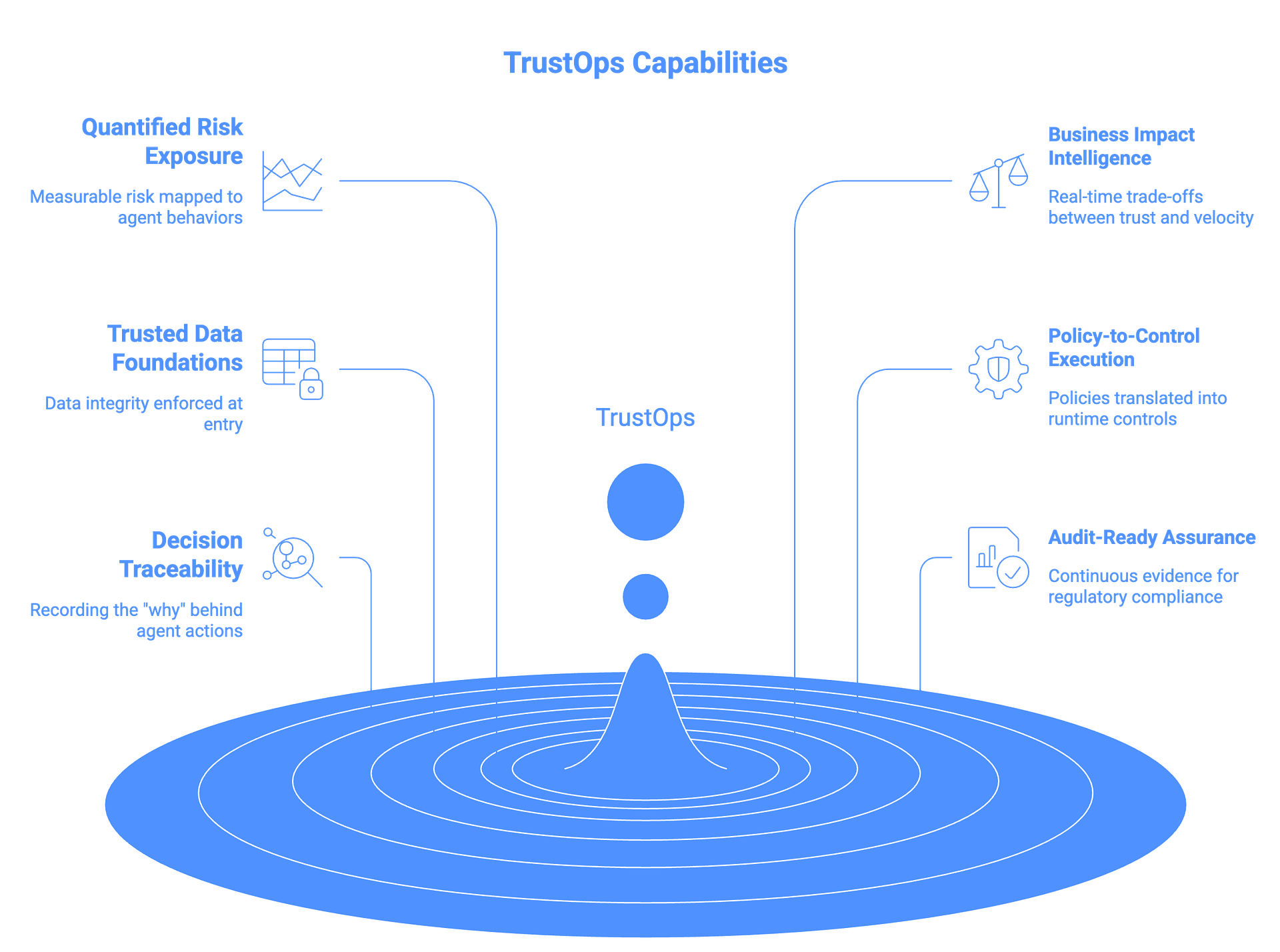
1. Quantified AI Risk Exposure
Risk has to be measurable to be manageable. TrustOps replaces qualitative risk language (“medium”, “high”) with quantified exposure mapped to specific agent behaviours, specific tool calls, and specific data flows. It tells you not just that there is risk, but where it lives, how it is trending, and what triggers it. This is the same shift cybersecurity made when CVSS scoring replaced “this vulnerability seems bad.”
2. Business Impact Intelligence
Every governance decision has a business cost. Pausing an agent that handles claims has a customer impact. Throttling a classifier has a latency impact. McKinsey estimates the agentic AI shift could add $2.6–4.4 trillion annually to the global economy but only if the trade-offs between trust and velocity are visible to the people making the calls. TrustOps connects risk signals to business signals so leadership can see the trade-offs in real time, not in a quarterly slide.
3. Trusted Data Foundations
AI systems are only as trustworthy as the data they consume. TrustOps treats data lineage, PII handling, and consent boundaries as first-class controls, enforced at the point where data enters the agent loop, not after the fact. The OWASP Agentic Top 10 places memory poisoning and tool misuse in this category for a reason once bad data enters the loop, the loop amplifies it.
4. Policy-to-Control Execution
Most governance frameworks stop at the policy. TrustOps closes the loop by translating policies into runtime controls: detectors, sampling rules, budget caps, allow-lists, and pause webhooks that actually run inside the agent’s execution path. This is what AWS’s recent agentic governance research calls “operationalising frameworks like NIST AI RMF, ISO and OWASP transforming them from static reference documents that require human interpretation into automated, continuous evaluations embedded across the entire agentic lifecycle.”
5. Decision Traceability
When an agent takes an action, TrustOps records why. Every decision is linked to its inputs, its reasoning trace, the policies that applied, and the events that came before it. Trace IDs and parent event IDs let teams reconstruct any decision path, end to end. As the recent Strata Identity governance analysis observed: “Compliance audits rely on logs that capture who accessed what and when, but they struggle to capture the intent, context, and delegation relationships that define agentic workflows.” TrustOps captures all four.
6. Audit-Ready Assurance
Audits should be a query, not a project. TrustOps maintains continuous, point-in-time evidence so that producing a regulator-ready report whether for MAS FEAT, IMDA AI Verify, NIST AI RMF, or ISO 42001 is a matter of selecting a date range, not assembling a war room. McKinsey’s 2026 RegTech analysis showed that financial institutions that moved from manual to automated compliance raised regulatory coverage from 75% to above 95%. Continuous evidence is the same shift, applied to AI.
These six capabilities are the spine. Everything else detectors, dashboards, redactors, scorecards – sits on top of this spine.
Part 4 : TrustOps vs Adjacent Categories
TrustOps is a new category, which means it gets confused with adjacent ones. The distinctions matter.
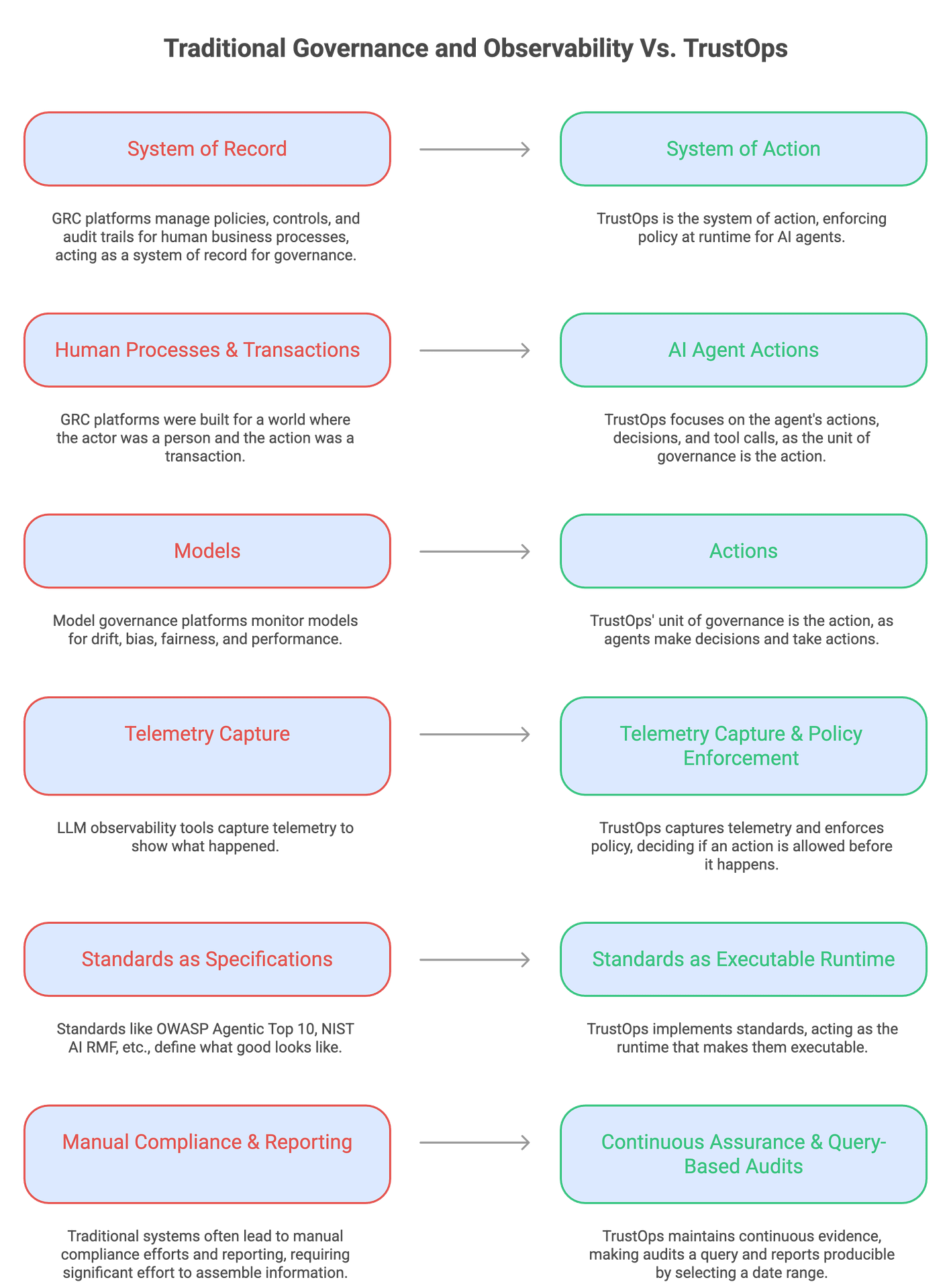
TrustOps is not GRC. GRC platforms (ServiceNow, MetricStream, Hyperproof) manage policies, controls, and audit trails for human business processes. They were built for a world where the actor was a person and the action was a transaction. They do not sit in an agent’s execution path. They do not see tool calls. They do not redact PII at the SDK boundary. They are the system of record for governance – TrustOps is the system of action.
TrustOps is not Model Governance. Model governance platforms (Credo AI, Fiddler, Arthur) monitor models – drift, bias, fairness, performance. That matters, but it is the wrong unit of analysis for agents. Models sit in pipelines. Agents make decisions, delegate tasks, and take actions. The risk profile is fundamentally different and the unit of governance is the action, not the prediction.
TrustOps is not LLM Observability. LLM observability tools (Langfuse, Helicone, Datadog LLM) capture telemetry. TrustOps captures telemetry and enforces policy. Observability tells you what happened. TrustOps decides whether what is about to happen is allowed.
TrustOps does not compete with standards. It implements them. OWASP Agentic Top 10, NIST AI RMF, ISO 42001, MAS AIRG, EU AI Act, IMDA AI Verify – these tell you what good looks like. TrustOps is the runtime that makes them executable. Standards are the spec. TrustOps is the build.
Part 5 : The TrustOps Operating Model
If TrustOps is to AI Governance what DevOps was to software delivery, what does its operating model look like?
We see four loops that distinguish a TrustOps-mature enterprise from one that is still doing AI Governance the old way.
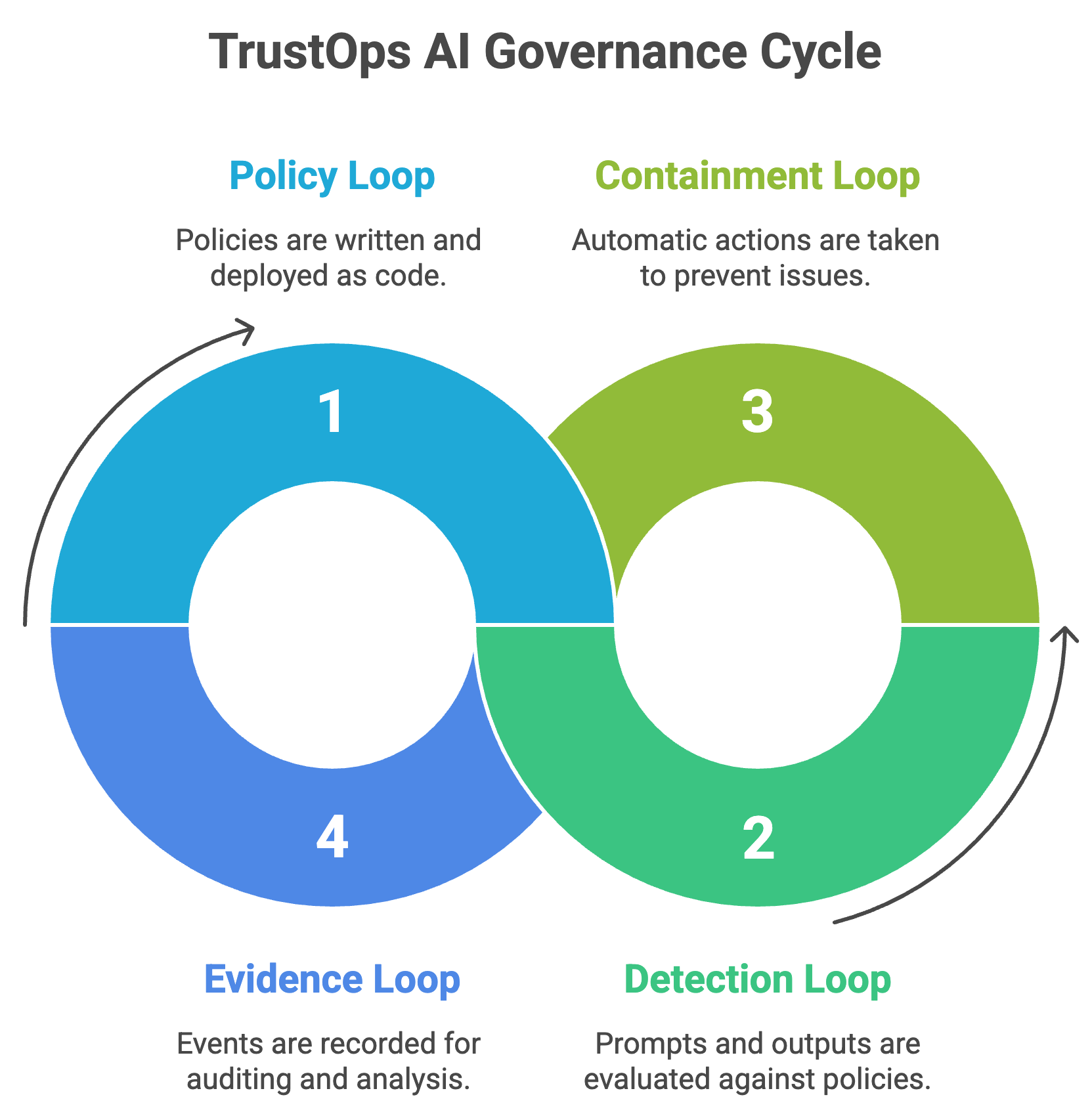
Loop 1 : The Policy Loop. Policies are written as code, version-controlled, peer-reviewed, and deployed to runtime detectors the same way any production change is deployed. When a policy changes, it changes in the agent’s execution path within minutes, not quarters.
Loop 2 : The Detection Loop. Detectors evaluate every prompt, tool call, and output against the policies bound to that agent. The detection happens in milliseconds, in the request path, before the side effect occurs. Microsoft’s open-source Agent Governance Toolkit (April 2026) calls this “deterministic, sub-millisecond policy enforcement”, the only enforcement model that scales to agent decision rates.
Loop 3 : The Containment Loop. When detection fires, containment is automatic and reversible: pause the agent, redact the output, escalate to human review, invoke a pause webhook. The principle is the same one that made circuit breakers work in microservices fail safely, log everything, route around the broken thing.
Loop 4 : The Evidence Loop. Every event in every loop above is recorded with full context i.e. trace ID, parent event ID, applied policies, detector verdicts, containment actions, business impact. Evidence is continuous, queryable, and tied to a risk taxonomy. Auditing becomes a SELECT statement.
These four loops are running constantly, in every agent, in every environment. That is what makes governance continuous. That is what makes it TrustOps.
Part 6 : How Protum Implements TrustOps Today
We are not theorising about TrustOps. We have built it.
Protum’s Trusted AI OS is the platform implementation of the six capability areas above. Each one maps to a product surface that ships today.
Agentic Risk Matrix (ARM). A catalogue of 42 agent-specific risks across 8 domains – Decision, Delegation, Execution, Interaction, Memory & Data, Identity & Access, Governance, and Value & Impact. The ARM goes beyond OWASP’s Agentic Top 10 by adding 14 risks that the standards do not yet cover, including delegation chain failures, value-stream disruption, and skills atrophy. Every risk in the matrix is wired to a runtime control. The catalogue is not a reference document – it is the index of what the runtime is actually watching.
Runtime Control Plane. Detectors sit in the agent’s execution path. They evaluate every tool call, every prompt, every output against the policies bound to that agent. When something crosses a line, the platform contains it: pausing the agent, redacting an output, escalating to human review, or invoking a configured pause webhook. Containment is automatic, recorded, and reversible.
Decision and Event Traceability. Every event in the runtime carries a traceId linking it to the broader request, and a parentEventId linking it to whatever triggered it. Any output can be unwound back through the chain of tool calls, prompts, and detector verdicts that produced it. Traceability is not bolted on – it is the spine.
Audit-Ready Evidence Reports. Protum produces point-in-time evidence reports for the frameworks that matter to regulated AI: MAS FEAT, IMDA AI Verify, NIST AI RMF, ISO 42001, EU AI Act, OWASP Agentic Top 10. Each report bundles agent behaviour, detector findings, control coverage, and decision traces into a single document an auditor can verify. Reports are generated on demand against the underlying TrustOps record, not maintained as a parallel artefact.
AI Risk Pricing and Classifier Spend Caps. Trust has a cost. Running large classifiers on every event is expensive; running none of them is reckless. Protum exposes per-tenant classifier spend caps and budget controls so teams can dial in the level of LLM-based detection on a per-agent and per-environment basis. Governance becomes a priced, observable line item rather than a hidden compute bill.
SDK-Level PII Redaction. Both the Node and Python SDKs redact PII before telemetry leaves the agent process. Sensitive data never reaches the control plane unprotected. Redaction is configurable, deterministic, and traceable – teams can prove what was redacted and why.
This is TrustOps in production. It is the system that lets a CIO answer the question every regulator, board member, and customer is now asking: “Show me what your AI did, why it did it, and prove the control was working at the time.”
Part 7: Why This Matters Now
Three forces make TrustOps the defining operating discipline of the next decade.
Regulators are converging on runtime evidence. The pattern is the same in every framework i.e. MAS FEAT, IMDA AI Verify, NIST AI RMF, ISO 42001, EU AI Act. Regulators want to see what the system actually did, not what the policy says it should do. Article 9 of the EU AI Act is explicit on this. NIST’s February 2026 Agent Standards Initiative is explicit on this. The Singapore IMDA AI Verify framework is explicit on this. Every serious regulatory regime is converging on the same expectation: continuous, evidence-based governance tied to actual system behaviour.
Boards are converging on continuous assurance. Deloitte’s 2025 Trustworthy AI research and McKinsey’s 2026 AI Trust Maturity work both point to the same conclusion: AI compliance is shifting from periodic certification to continuous monitoring. Banks with structured AI compliance frameworks have demonstrated 83% reductions in regulatory penalties and 91% faster regulatory filing preparation compared to institutions without systematic governance. The board-level question is no longer “do we have a policy?”, it is “can we prove the policy was running?”
The agents themselves are converging on autonomy. Multi-agent systems, MCP-based tool access, A2A protocols, and persistent memory are no longer experimental. They are the production stack. Every additional layer of autonomy widens the gap between what the architecture document describes and what the system actually does. TrustOps is the only operating discipline designed for that gap.
The convergence is the signal. Regulators, boards, and the technology itself are all asking the same question, and they are asking it of the same systems.
If your governance programme today produces a slide deck, a risk register, and a quarterly committee but not a runtime, it is incomplete. Governance defines what should be true. TrustOps makes it true, continuously, and proves it.
Closing: The DevOps Inflection, Again
Every operating discipline that has ever scaled in technology started the same way. Someone noticed that the gap between what was documented and what was running had become structural. Someone gave the gap a name. Someone built the operating model that closed it.
Configuration management did it for infrastructure. Continuous integration did it for code. SRE did it for reliability. DevOps did it for delivery.
TrustOps does it for AI Governance.
The discipline is real. The market is forming. The regulators are watching. The technology is here. What remains is the choice every CIO, CRO, and Chief AI Officer now has to make:
Run AI Governance as a document or run it as a system.
If you are building, deploying, or scaling agents in production, we would invite you to start with a full Security assessment. We will map your current AI surface, identify your highest-exposure agentic risks, and show you exactly where TrustOps would change the picture.
The next AI incident will not be a model hallucinating. It will be an agent doing exactly what its policy allowed — cleanly, correctly, and producing an outcome the business cannot undo.
TrustOps is how you make sure the policy was right in the first place and how you prove it, continuously, when the regulator asks.
Protum is the Trusted AI Operating System for the agentic enterprise. Our Agentic Risk Matrix, runtime control plane, decision traceability, and audit-ready evidence reports give CIOs, CROs, and Chief AI Officers the operational backbone for trustworthy AI at scale. Learn more at protum.ai.
Key References & Further Reading
- Gartner, February 2026 Global AI Regulations Fuel Billion-Dollar Market for AI Governance Platforms: AI governance spending forecast — $492M in 2026, $1B+ by 2030.
- Gartner, March 2026 Top Predictions for Data and Analytics 2026: 50% of AI agent deployment failures by 2030 will be due to insufficient governance runtime enforcement.
- Gartner, February 2026 Top Cybersecurity Trends 2026: AI governance gaps designated tier-1 cybersecurity risk; $244B enterprise security spend in 2026.
- OWASP, December 2025 Top 10 for Agentic Applications 2026: First formal taxonomy of risks specific to autonomous AI agents.
- Microsoft Open Source, April 2026 Agent Governance Toolkit: Reference architecture for sub-millisecond runtime policy enforcement against the OWASP Agentic Top 10.
- EU AI Act, August 2026 enforcement Article 9 (continuous risk management) and Article 12 (logging requirements) for high-risk AI systems.
- NIST AI Agent Standards Initiative, February 2026 Agent identity, security, and observability as core standardisation pillars.
- McKinsey, March 2026 Ushering in a New Era of Trusted AI: AI Trust Maturity Model and the case for compliance automation.
- Oracle, April 2026 Runtime Governance for Enterprise Agentic AI: The OCI four-layer framework and the concept of the governed action trajectory.
- Norton Rose Fulbright, April 2026 Rethinking Governance for Agentic AI: Legal analysis of enforced trust boundaries.
- AWS Machine Learning Blog, March 2026 AI Risk Intelligence in the Agentic Era: The case for framework-agnostic, continuous governance.
- CSA Labs, March 2026 EU AI Act High-Risk Deadline Research Note: Enterprise readiness statistics and breach correlation data.
- Deloitte, 2025–2026 Trustworthy AI Services and Agentic AI in Banking: Embedding compliance at the core of agentic AI.
- Strata Identity, April 2026 Agentic AI Governance: How to Approach It: The identity and delegation layer of agentic governance.