By [Sandeep Joshi/For Massivue Insights]
Singapore, as a leading global financial hub, and businesses worldwide stand at a critical inflection point. The comfortable equilibrium that defined the past is under unprecedented strain, not from cyclical market fluctuations, but from a fundamental shift in the underlying forces of value creation. Our analysis reveals a powerful compression dynamic, driven by the accelerating leverage of artificial intelligence, forcing businesses to radically adapt or risk obsolescence.
This isn’t a distant threat. Consider the recent actions of industry titans, as well as the pressing realities within the financial services sector:
- The Efficiency Imperative: Microsoft, a bellwether of the tech sector, recently announced a further 9,000 job cuts, adding to the 15,000 reductions over the preceding two months. This significant ~6.6% decrease in their 228,000-strong workforce (now 213,000) across gaming, sales, and product development underscores a decisive move towards prioritizing efficiency through technological augmentation. Notably, this workforce reduction coincides with continued revenue growth, demonstrating a clear substitution of overhead for compute. This trend is particularly challenging for professional services firms, where headcount directly correlates with revenue generation – a model that will face increasing pressure.
- The Value of Proprietary Data: Cloudflare’s proactive stance on data access highlights the emerging value of high-quality, human-generated content in the age of AI. By implementing default blocking of AI crawlers, they have empowered over 1 million customers to control access to their data. This strategic move, backed by major publishers, signifies a paradigm shift. Indiscriminate data scraping is giving way to a permission-based economy, where AI companies will need to pay for premium training datasets. This transformation represents a profound revaluation of digital content and the creation of entirely new revenue streams for those who control valuable data.
- The Battle for Integrated Platforms: Grammarly’s recent acquisition of Superhuman follows its late 2024 acquisition of Coda, signaling a strategic pivot towards building a comprehensive “premium productivity suite.” This move comes in response to the deceleration of their core offering’s growth to 12% year-over-year, bringing their Annual Recurring Revenue (ARR) to $700 million. This slowdown can be attributed to the native integration of text assistance features by tech giants like Microsoft, Google, and Apple, effectively commoditizing Grammarly’s initial value proposition. Their platform consolidation strategy, while ambitious, faces the inherent challenges of gaining traction against established ecosystems with significant distribution advantages.
These seemingly disparate actions are unified by a common thread: the aggressive pursuit of technology leverage, predominantly through the integration and strategic application of AI. While much of the discourse around AI focuses on future potential, the reality is that its transformative power is already reshaping business models and competitive landscapes.
Six Pillars of Compression and the Path to Resilience
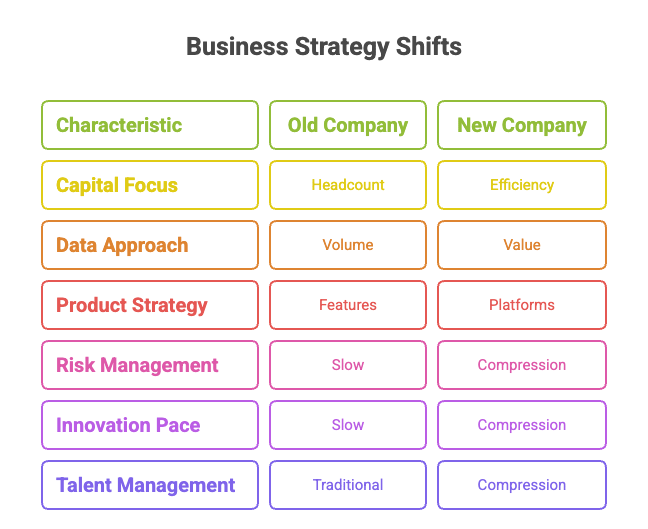
Our expanded analysis identifies six key patterns driving this compression, reflecting the multi-faceted impact of AI:
- Efficiency Over Headcount: Companies are increasingly substituting human capital with advanced computational power. This trend necessitates a fundamental rethinking of operational models. The inability to adapt creates a significant opportunity for agile “NewCos” unburdened by legacy structures.
- Value Over Volume: The era of freely accessible data is rapidly closing. As AI models become more sophisticated, the demand for high-quality, curated data will surge. Businesses must develop strategies to identify, protect, and leverage their unique data resources.
- Platforms Over Features: Standalone functionalities are increasingly susceptible to commoditization by larger players with integrated ecosystems. This highlights the need to build defensible platforms that offer a comprehensive and sticky user experience.
- Risk & Trust Compression: The rapid deployment of AI brings new forms of risk – ethical dilemmas, data privacy breaches, algorithmic bias, and security vulnerabilities. Organizations face pressure to build robust governance frameworks and transparent AI systems, as trust (or lack thereof) can quickly compress market share and brand value. Failure to manage these risks will lead to significant reputational and financial costs, rapidly eroding customer and regulatory confidence.
- Innovation Cycle Compression: The speed at which AI-driven innovations emerge and become table stakes is accelerating dramatically. What was once a competitive advantage can become a minimum requirement overnight. Organizations are compressed into a much shorter innovation cycle, demanding constant vigilance, rapid experimentation, and agile development to avoid being outpaced.
- Talent & Skills Compression: The skills required for success are evolving at an unprecedented pace. Traditional job roles are being redefined, augmented, or rendered obsolete by AI. This creates a dual compression: a shortage of new, AI-native skills (e.g., prompt engineering, AI ethics) and the rapid depreciation of existing skills. Organizations face intense pressure to reskill and upskill their workforce, or risk a significant talent gap that inhibits their ability to leverage AI effectively.
The Compression in Financial Services: Banking and Insurance in Focus
The financial services sector, particularly banking and insurance, is experiencing these compression forces acutely. Singapore’s financial institutions are recognized globally for their early adoption of AI, with over 70% of financial institutions in Singapore already having implemented AI solutions in some capacity, and another 20% actively exploring options (MAS data, 2025). This positions Singapore as a leader, yet the challenges remain significant.
Example 1: The Banking Industry – A Race for Hyper-Personalisation and Risk Management
Traditional banking models, often reliant on extensive branch networks and manual processes, are under immense pressure to adapt to the digital-first expectations of customers and the sophisticated analytical capabilities of AI.
- Efficiency Over Headcount in Banking: Banks in Singapore face an “unprecedented” challenge with clients abandoning due to slow and inefficient onboarding processes, with nearly 90% of C-level executives reporting client loss due to such delays in the past year (Fenergo study, 2025). This stems from poor data management and siloed workflows, where only 1% of banks have successfully automated the majority of their KYC and onboarding processes. AI offers a direct solution. For instance, DBS is equipping its 500-strong Customer Service Officer (CSO) workforce in Singapore with a Gen AI-powered virtual assistant by end-2024. This “CSO Assistant” is expected to reduce call handling time by up to 20% by transcribing queries in real-time, retrieving information, and automating post-call documentation, directly addressing the “Efficiency Over Headcount” imperative. Furthermore, McKinsey notes that financial institutions leveraging AI for risk assessment have reduced default rates by 20-30% and accelerated loan approvals by 40%, demonstrating a clear shift from manual risk analysis to AI-driven predictive modelling.
- Risk & Trust Compression in Banking: The financial sector is a prime target for AI-powered fraud. A significant concern is the rise of deepfake fraud, which has seen a 194% increase in APAC, with Singapore experiencing a 207% surge in identity fraud attempts (Sumsub report, 2024). Banks must invest heavily in AI for anomaly detection, biometric authentication, and robust cybersecurity to maintain customer trust and regulatory compliance. The “always-on” nature of financial transactions and the increasing sophistication of cyber threats compress the window for manual intervention, demanding real-time, AI-powered risk mitigation.
Example 2: The Insurance Industry – From Reactive Claims to Proactive Risk Prevention
The insurance sector, historically reliant on actuarial tables and post-event claims processing, is being fundamentally reshaped by AI’s ability to assess risk in real-time and predict future events.
- Innovation Cycle Compression in Insurance: The emergence of real-time data from IoT devices (telematics in vehicles, wearables for health) and satellite imagery for property insurance is compressing the innovation cycle. Insurers are now under pressure to rapidly develop AI models that can leverage this streaming data for dynamic pricing, personalized risk assessment, and even proactive interventions (e.g., sending alerts to drivers about hazardous road conditions). Companies that are slow to integrate these new data sources and AI models will quickly lose ground to more agile competitors offering superior, personalized products.
- Talent & Skills Compression in Insurance: The traditional insurance workforce, skilled in actuarial science and manual claims assessment, faces rapid obsolescence. There is an increasing demand for data scientists, AI engineers, and ethical AI specialists who can build and manage complex predictive models. For example, a global survey by PwC found that 75% of insurance executives believe AI will significantly impact their workforce, requiring substantial reskilling. Insurers must rapidly invest in upskilling their existing employees in data literacy and AI tools, while simultaneously attracting new talent with these specialized capabilities, or face severe competitive disadvantages.
Reinvention: The Dual Engine for Compression Resilience
Organisations’ proactive approach to reinventing their business model and talent strategy are not merely responses to compression; they are the primary mechanisms for turning compression into competitive advantage.
Business Model Reinvention: Adapting the “What” and the “How”
Business model reinvention, driven by AI, is about fundamentally altering what value is delivered and how it’s captured. This directly addresses the compression pillars:
- Shifting from Product to Service (Efficiency & Platforms): AI enables the move to “as-a-service” models, where physical products are augmented or replaced by continuously updated, AI-powered services. This transforms capital expenditures into operational ones for customers and creates recurring revenue streams for companies.
- Example: A traditional machinery manufacturer might shift to offering “uptime-as-a-service,” where AI monitors equipment performance, predicts failures, and schedules preventive maintenance, charging based on machine availability rather than selling the machine outright. This leverages AI for efficiency (predictive maintenance, less human intervention) and builds a platform around the service.
- Creating AI-Native Offerings (Innovation Cycle & Value): Beyond augmenting existing products, reinvention involves designing entirely new products and services that could only exist because of AI. These are often highly personalized or predictive.
- Example: In healthcare, AI-driven diagnostics are not just faster, but can identify patterns imperceptible to humans, leading to novel treatment pathways. A pharmaceutical company might reinvent its R&D model by using generative AI to design new drug molecules, significantly accelerating drug discovery and creating entirely new intellectual property (Value Over Volume).
- Orchestrating Ecosystems (Platforms & Risk/Trust): Business model reinvention often extends beyond a single organization, creating collaborative ecosystems. AI can facilitate these by enabling seamless data exchange and coordinated action across partners.
- Example: A logistics company might create an AI-powered platform that optimizes supply chains not just for its own fleet, but for an entire network of carriers, warehouses, and clients, sharing data securely and providing real-time visibility. This builds a dominant platform, but requires careful management of data sharing and trust (Risk & Trust Compression).
Talent Approach Reinvention: Reshaping the Workforce for Leverage
The talent approach is equally critical, directly mitigating Talent & Skills Compression and enabling the other pillars:
- Skills-Based Organization: Moving away from rigid job descriptions to a dynamic skills-based approach allows organizations to identify current capabilities, anticipate future needs, and rapidly deploy talent where AI creates new demands. This involves robust internal talent marketplaces powered by AI.
- Statistic: IBM uses an AI career assistant to recommend next roles to employees and even suggest necessary training, which has been shown to increase retention by up to 20% and reduce attrition by 35% by enabling internal mobility.
- AI Literacy & Upskilling: Proactive investment in comprehensive AI literacy programs for all employees, not just technical roles, is essential. This ensures that the workforce can effectively interact with AI tools, interpret AI insights, and adapt to AI-augmented workflows.
- Statistic: Companies that use AI in training report a 72% increase in employee engagement with learning content and improved knowledge retention by 60% (Engagedly data).
- Human-AI Collaboration (Augmented Workforce): The focus shifts from human replacement to human augmentation. Talent strategies must foster symbiotic relationships between humans and AI, where AI handles routine tasks, allowing humans to focus on higher-order cognitive functions like creativity, critical thinking, and empathy.
- Example: In customer service, AI chatbots handle FAQs, but complex emotional interactions are escalated to human agents armed with AI-generated customer insights.
The comfortable middle is not passively fading; it is being actively reshaped by those who understand and effectively harness the power of technology leverage. The choice is clear: either embrace this transformation and redefine your business for the AI era, or risk being compressed.
Contact Massivue today to understand how our AI Business Canvas and consulting services can empower your organization to not just survive, but thrive in this new landscape.