Series: The Hardest AI Problem Isn’t Tech. It’s Mindset.
We began this series by challenging the naive belief that successful AI adoption is just about buying the right model or hiring a Chief AI Officer. The real chasm to cross is one of culture, structure, and human behaviour. You can deploy the world’s best Large Language Model (LLM), but if the input is garbage, the output will only be Garbage In, Amplified Out.
This brings us to the first, and most foundational, capability of the Protum™ AI operating model: Data Culture. This capability is the bedrock for data-driven decision-making and information governance for organisational excellence.
The Problem: Your Data is Not an Asset, It’s a Hoarding Habit
Most traditional enterprises treat data as a liability or, at best, a guarded asset. This is a mindset rooted in scarcity and ownership:
- Silo Power: Data is seen as the intellectual property of the department that generated it (e.g., Sales owns customer data, Operations owns process data). Hoarding it is a source of internal power and job security.
- Insecurity & Fear: There is a pervasive culture of not sharing because of the fear of misinterpretation, compliance risk, or having one’s work scrutinised by other teams.
- Quality Complacency: Because data is rarely scrutinized by an external team that needs to use it, the generating department maintains a “good enough” standard for their own local needs, leaving it inconsistent, fragmented, or poorly documented.
This status quo creates “Data Deserts” — vast amounts of stored data that are effectively unusable by the systems that need them most: AI and Machine Learning. AI models, which thrive on vast, high-integrity, and diverse datasets, are choked by organisational friction long before they hit a technical roadblock.
The Protum™ Shift: From Hoarding to Fuelling
A true Data Culture replaces this scarcity mindset with one of shared strategic purpose. The core shift is from Data Ownership to Data Stewardship.
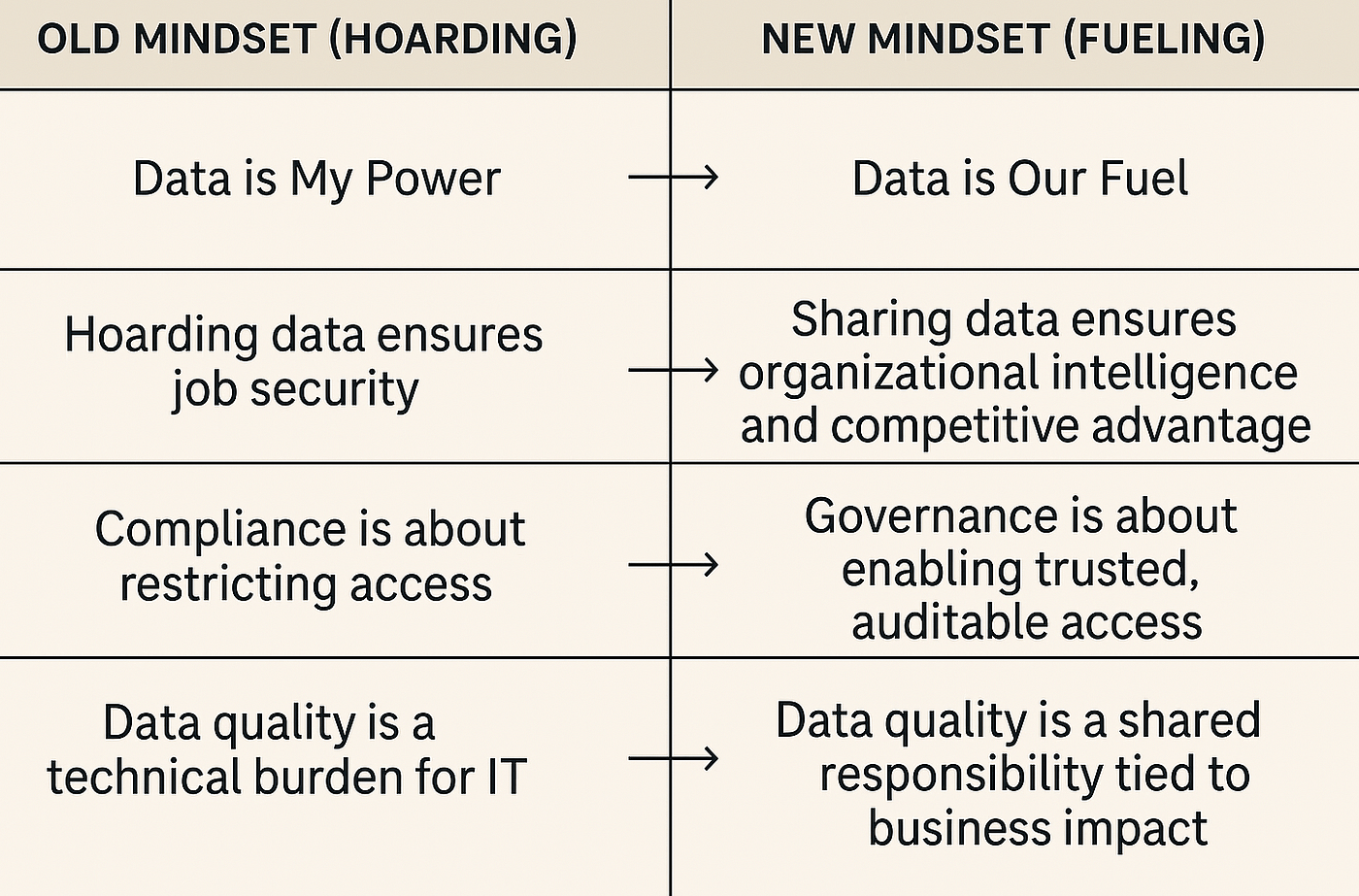
This cultural transformation is activated by defining and implementing the right elements across the organization.
Implementing Elements of a Data Culture
To make the Data Culture shift tangible, Protum™ defines four practical elements that must be structurally implemented:
- Data & Insights: AI-ready data architecture and intelligent analytics
This ensures all data is structured, standardised, and accessible via a unified architecture (like a data fabric or mesh) that prioritises machine readability and integration with AI services.
2. Measures: Multi-dimensional metrics and performance intelligence
This capability moves beyond simple KPIs to sophisticated, unified metrics that capture end-to-end customer and business value, which AI systems use to align and optimize decisions.
3. Technology: AI-first tech stack enabling data-driven decisions
This is the infrastructure layer: selecting and integrating technologies (cloud, platforms, tools) that are inherently designed for high-speed data ingestion, processing, and real-time decision support for both human and AI users.
4. Governance: Data ethics, privacy, and intelligent decision frameworks
This is the guardrail: establishing clear policies for data privacy, ethical use, and auditing of AI-driven decisions, ensuring that the organization can accelerate its use of data with trust and compliance.
Assessing the Data Culture Shift by Level
Success is not a declaration; it’s a measurable set of behaviours. We assess the maturity of the Data Culture across three organisational levels:
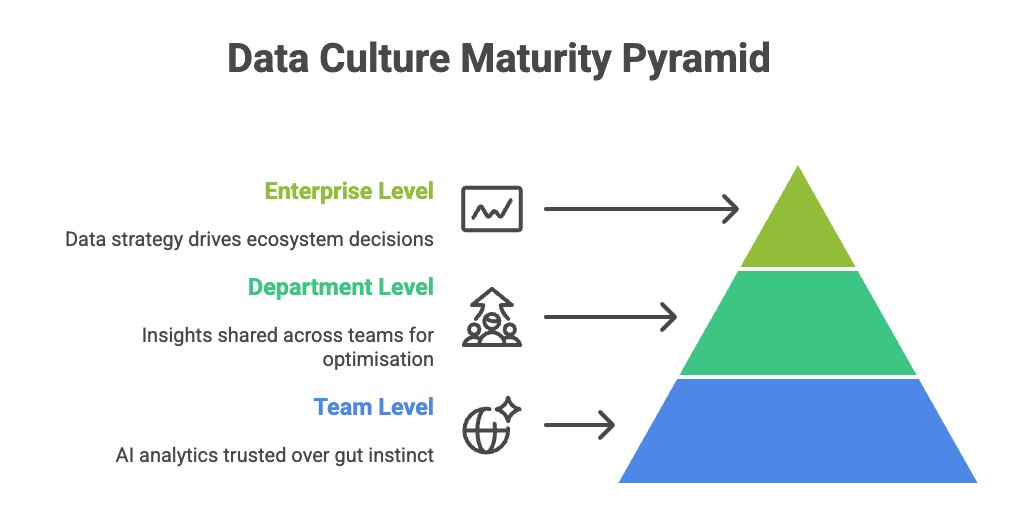
Simple Questions as litmus test for Data Culture
Team Level
Does the team use AI analytics for daily decisions?
Individual contributors trust AI-driven insights over gut instinct in their routine tasks.
Department Level
Are insights shared across teams for optimisation?
Silos are broken: Marketing proactively shares campaign data with Sales for forecasting; Finance uses Operations data for real-time cost analysis.
Enterprise Level
Does data strategy drive ecosystem decisions?
The highest level of governance: Data integrity and accessibility are the primary constraints for M&A, vendor selection, and new product architecture.
The Takeaway
The AI revolution is not waiting for a better algorithm; it’s waiting for a better data foundation. Investing in AI tools without first investing in the cultural shift to Data Culture is like buying a Ferrari and only fuelling it with low-grade, contaminated gas. It will stall out.
The leaders who succeed will be those who stop treating data as a static asset to be guarded and start seeing it as the real-time, flowing fuel that powers every AI decision.
Next in the Series: Part 2: The Structure Shift: Dismantling the Org Chart for AI-Native Flow.
For a deeper look at the full Protum™ framework and to see these six capabilities in action, visit protum.ai.