For the past two years, enterprise AI leadership was defined by a battle against the “POC Graveyard” – wrestling disconnected pilots, compliance bottlenecks, and unstructured data into a coherent operating model.
Now, a far more disruptive inflection point has arrived.
The enterprise is rapidly moving past passive copilots that wait quietly for a text prompt. Instead, organizations are deploying autonomous, goal-driven multi-agent systems: synthetic entities capable of decomposing complex objectives, calling internal APIs, orchestrating multi-step workflows across ERPs and CRMs, and executing real-world business transactions.
This changes the fundamental nature of the role. When software merely processes information, you manage a technology pipeline. But when software initiates actions, makes operational judgments, and negotiates outcomes across departmental silos, you are no longer managing code.
You are orchestrating a synthetic workforce.
The Head of AI must now step into a hybrid mandate that blends enterprise architecture, organizational design, and labor capacity planning. Here is the operational playbook for leading that shift.
1. The Critical Distinction: Tools vs. Synthetic Labor
Traditional enterprise IT is built around deterministic tools. An employee clicks a button, a database updates, and an expected output returns. Even early generative AI copilots operated largely within this user-initiated sandbox: human in, human review, human out.
Multi-agent architectures break this paradigm entirely:
- Initiative: Agents do not wait for granular instructions; they evaluate an objective state and plan the intermediate steps required to reach it.
- Non-Deterministic Execution: Two agents tackling the same business outcome may navigate APIs, parse documentation, and synthesize findings via completely different paths.
- Blast Radius: When an autonomous system is granted write permissions to enterprise databases, procurement systems, or customer communications, a software failure is no longer just a bug—it is an operational, regulatory, and financial liability.
Treating autonomous agents as “just another SaaS integration” is a recipe for operational chaos. They require an organizational operating model comparable to onboarding, supervising, and auditing human labor.
2. Restructuring the Enterprise: The Diamond-Shaped Workforce
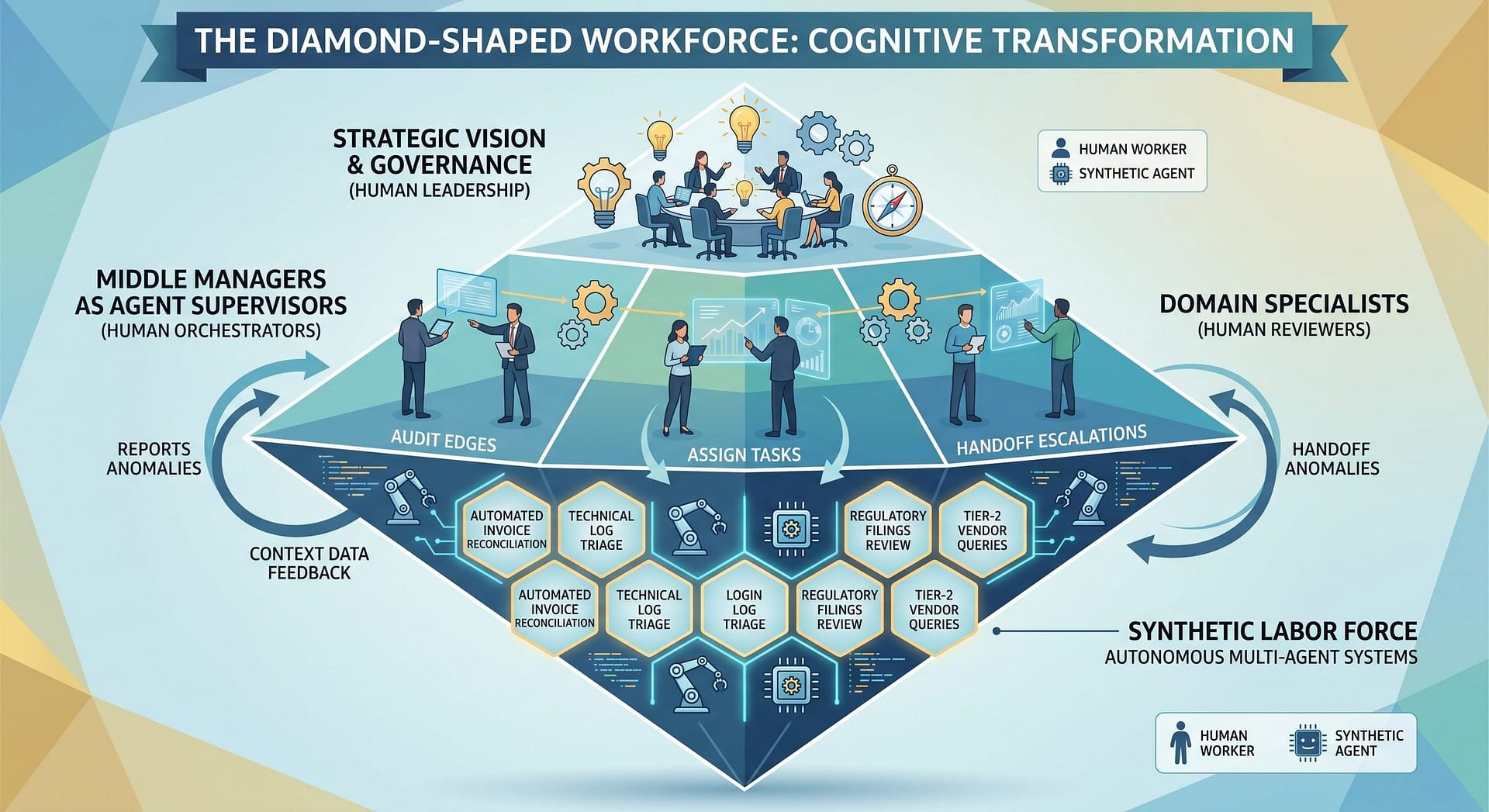
As specialized agents assume repetitive cognitive workloads—such as automated invoice reconciliation, technical log triage, regulatory filings review, and tier-2 vendor queries—the traditional enterprise pyramid collapses into a diamond structure.
- The Top (Strategic Vision & Governance): Senior human leadership defining business intent, ethical guardrails, capital allocation, and market strategy.
- The Middle (Human Orchestrators & Reviewers): Rather than executing raw volume, middle managers and domain specialists transition into Agent Supervisors. They design evaluation harnesses, audit anomalous edge cases, handle complex relationship-driven escalations, and fine-tune agentic task assignments.
- The Foundation (Synthetic Labor Force): Hundreds of task-specialized, communicating digital workers operating continuously at machine speed.
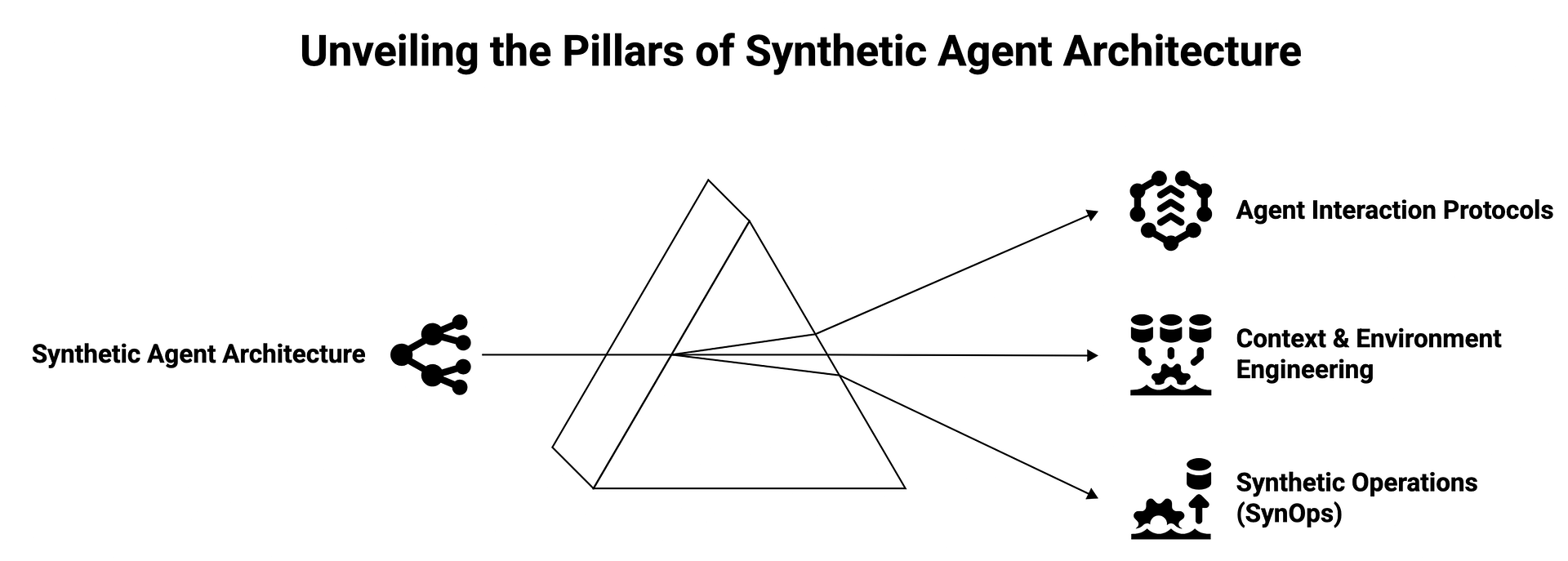
To govern this architecture effectively, the Office of the Head of AI must institutionalize three new operational capabilities:
- Agent Interaction Architecture: Designing standardized protocols for how synthetic agents discover, trust, and communicate with other internal and external agents.
- Context & Environment Engineering: Ensuring agents operate with accurate, unified enterprise ground truth rather than fragmented, conflicting departmental data.
- Synthetic Operations (SynOps): Managing machine identity lifecycle, token telemetry, execution latency, error budgets, and continuous behavioral drift monitoring.
3. The Four Pillars of Agent Orchestration
Scaling from five experimental agents to an interconnected network of hundreds requires robust architectural governance across four core pillars:
┌────────────────────────────────────────────────────────────┐
│             Enterprise Agent Orchestration                 │
├─────────────┬─────────────┬───────────────┬────────────────┤
│ 1. Topology │ 2. Shared   │ 3. Bounded    │ 4. Labor       │
│ & Patterns  │ Context     │ Autonomy      │ Accountability │
└─────────────┴─────────────┴───────────────┴────────────────┘
Pillar 1: Modular Topology over Monoliths
Attempting to build a single “omnipresent” agent with access to everything is an anti-pattern that leads to high hallucination rates and uncontrollable context windows. Resilient organizations deploy hierarchical and specialized agent networks:
- Supervisor Agents: Ingest macro business goals, decompose them into structured work packets, assign them to functional worker agents, and synthesize the final outcome.
- Domain Specialists: Constrained, purpose-built agents equipped with strict domain toolkits (e.g., a contract parsing agent, an SQL extraction agent, a reconciliation validator).
Pillar 2: Shared Context & Protocol Handoffs
Cascading errors are the single greatest threat to multi-agent production systems. If Agent A extracts flawed context from a customer interaction, Agent B will formulate faulty operational logic, and Agent C will execute an erroneous transaction.
Solving this demands stateful memory architectures with standardized, typed handoff contracts between agents, ensuring that intent, constraints, and audit trails remain preserved end-to-end.
Pillar 3: Bounded Autonomy & Dynamic Guardrails
Autonomy cannot be a binary toggle. It must be a calibrated continuum mapped against transactional risk:
- Tier 1 (Autonomous Execution): Read-only data aggregation, internal cross-referencing, synthesis, and drafts. Machine runs, machine logs.
- Tier 2 (Human-on-the-Loop): Standard transactional workflows with low-to-medium financial impact (e.g., issuing standard vendor POs under $5,000). The agent acts autonomously, but notifications and reversal windows exist for human intervention.
- Tier 3 (Human-in-the-Loop): Irreversible, high-stakes actions (e.g., executing material vendor contracts, modifying compliance postures, deploying production code). The agent compiles complete evidence packets, but the explicit execution key remains strictly with a human sponsor.
Pillar 4: Labor Accountability and SLA Parity
If an agent acts as a digital worker, it must be evaluated like one. The Head of AI must enforce rigorous behavioral SLAs:
- Task Completion Rate vs. Human Baseline
- Hallucination & Drift Rates across Operational Cycles
- Intervention Frequency (how often human supervisors had to step in)
- Cost per Resolved Unit of Work (token economics vs. full-time equivalent output)
4. What Breaks in Production: The Operational Blindspots
- Machine Identity & Permission Creep: Enterprise security teams often scramble to assign agent access. Giving an agent generic service-account privileges across wide data repositories invites severe security posture degradation. Every agent must possess a scoped, auditable identity with just-in-time, least-privilege token permissions.
- The “Infinite Loop” Runaway Cost: When agents encounter edge cases, poorly architected reflection or self-correction loops can spin out of control, consuming millions of tokens in minutes without converging on a resolution. Hard token budgets, step caps, and circuit breakers are mandatory.
- The Organizational Trust Deficit: Human employees will either over-trust an agent (rubber-stamping bad output without diligence) or actively resist it (refusing to hand off work to digital colleagues). Overcoming this requires transparent operational interfaces where agents explicitly expose their confidence intervals and reasoning traces to their human counterparts.
5. The Mandate for Modern AI Leadership
The previous decade was about digital transformation—digitizing paper, migrating infrastructure to the cloud, and building dashboard visibility.
This decade is about cognitive transformation.
Organizations that win will not merely be those that benchmark the fastest open-source models or sign the largest cloud compute agreements. Competitive advantage will belong to the enterprises that master the operating model: structuring collaborative networks where specialized agents amplify human judgment and scale execution without sacrificing security, governance, or trust.
As the Head of AI, you are no longer just an enterprise technologist. You are the architect of the modern workforce.
I help Chief AI officers, CIO and their leaders to deliver tangible transformation outcomes. If you’re looking for unbiased and trusted advisory or build capability, reach out to us at hello@massivue.com